

Review of Rocket21 – A Promising Prop Trading Platform
Rocket21 has quickly made a name for itself in the trading community by offering a transparent evaluation system and flexible funding options. Below is an in-depth analysis of the key aspects of this platform, providing you with a complete overview of its opportunities and risks.
I. Key Features and Evaluation Process
Two-Stage Evaluation Process
Rocket21 provides a clear two-step evaluation before granting a funded account:
Stage 1: R21 Challenge
- Traders need to achieve “8% profit” on the demo account.
- There is “no time limit”, reducing pressure and increasing the chance of success.
Stage 2: Verification
- Achieve an additional “5% profit”. Upon passing this stage, traders officially become Rocket Traders and receive a funded account.
A unique feature is the “Revive option”, which allows traders to “buy back access to the verification stage” if they fail to meet the requirements the first time.
II. Detailed Analysis of Account Types
Rocket21 offers different account structures to cater to traders of all experience levels, from beginners to seasoned professionals. Below are the “main account types” with their distinctive features and benefits.
2.1. Standard Account
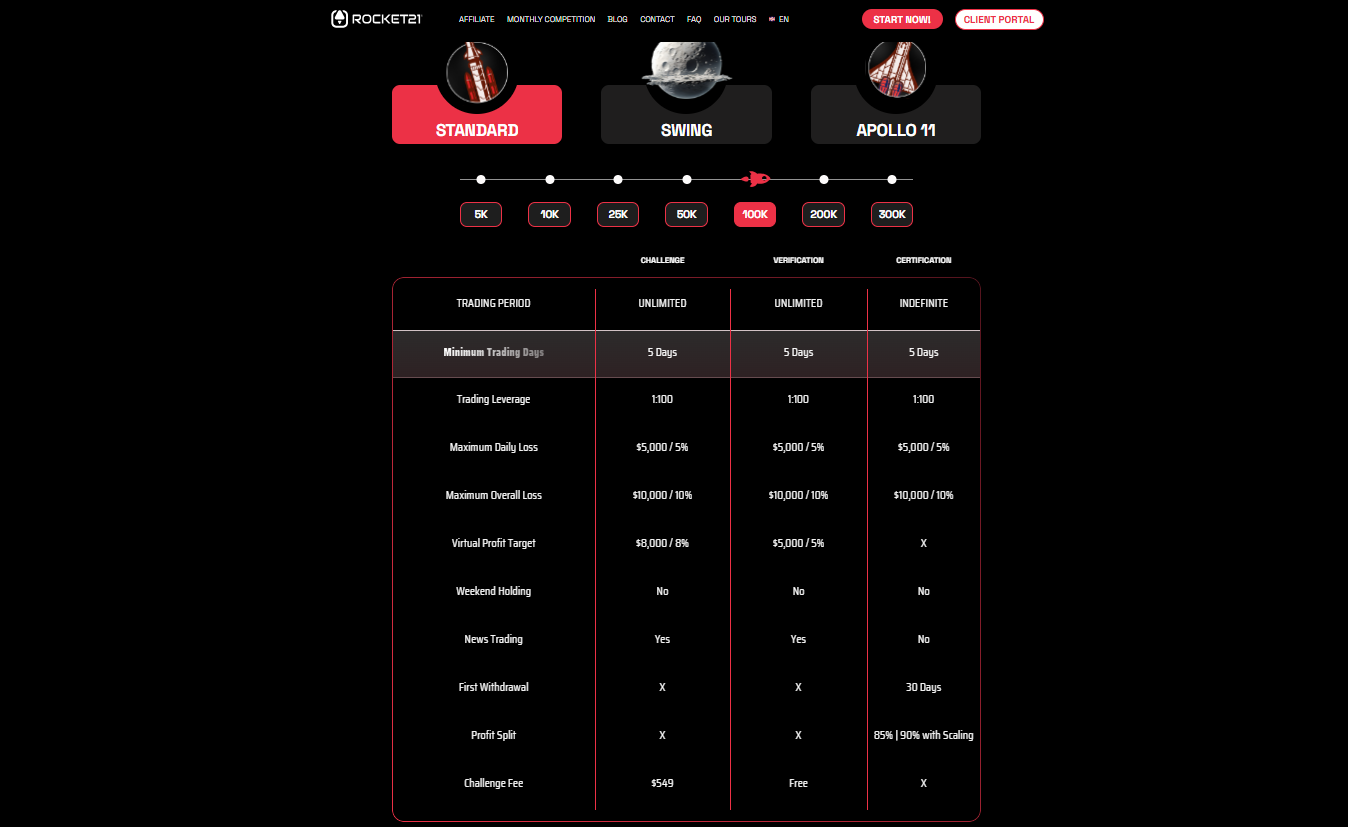
Two-stage evaluation process:
- Stage 1: Achieve “8% profit” on the initial balance.
- Stage 2 (Verification): Achieve another “5% profit”.
- No time limit to complete the challenge.
- Initial capital: Ranges from $5,000 to $300,000.
- Profit-sharing: 85% to 90%.
- Daily loss limit: 5%, with a maximum drawdown of 10%.
-> This account type is suitable for traders looking for a structured, non-pressured evaluation. Without a time limit, traders can better manage risks and develop sustainable strategies.
2.2. Swing Account
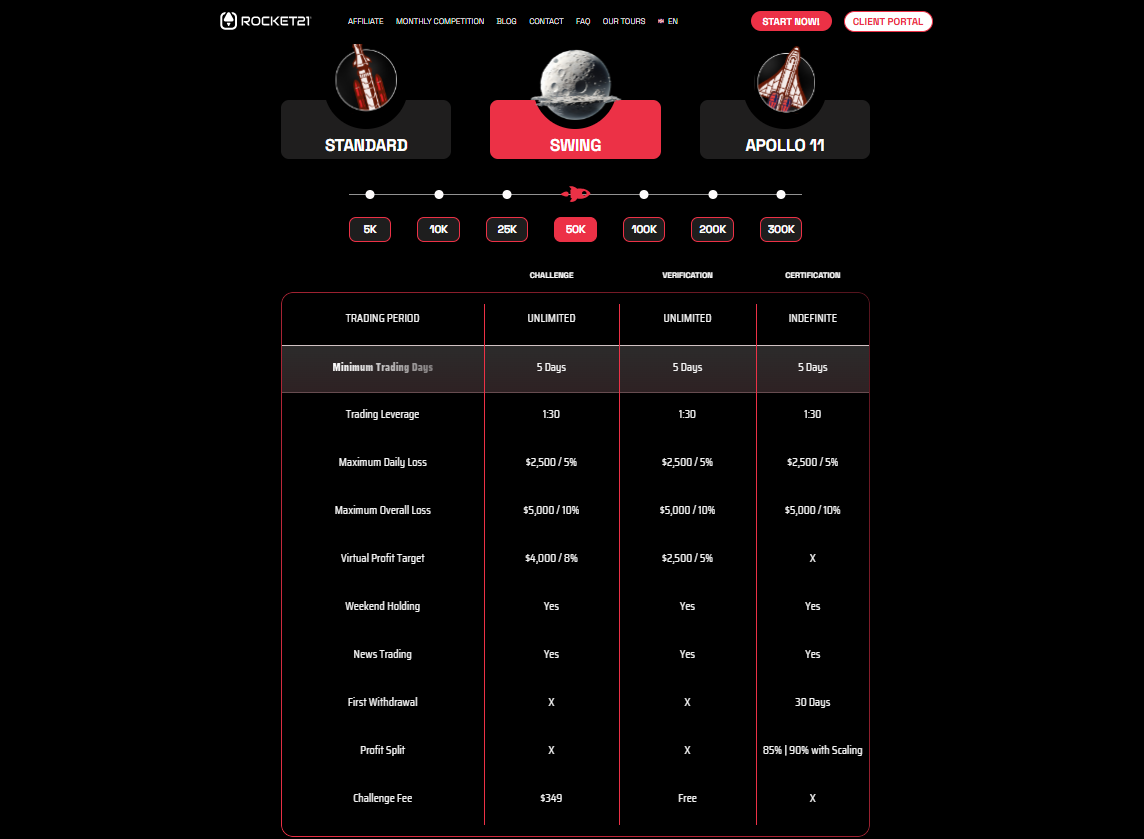
- Allows weekend trading and holding positions overnight, ideal for long-term strategies.
- Evaluation is similar to the Standard Account: 8% profit in Stage 1 and 5% in Stage 2.
- Risk limits are the same as the Standard Account: 5% daily loss and a 10% trailing drawdown.
_> This account is perfect for traders who want to take advantage of off-hours or weekend opportunities, making it a better choice for those focusing on news events or long-term trades.
2.3. Apollo11 Account
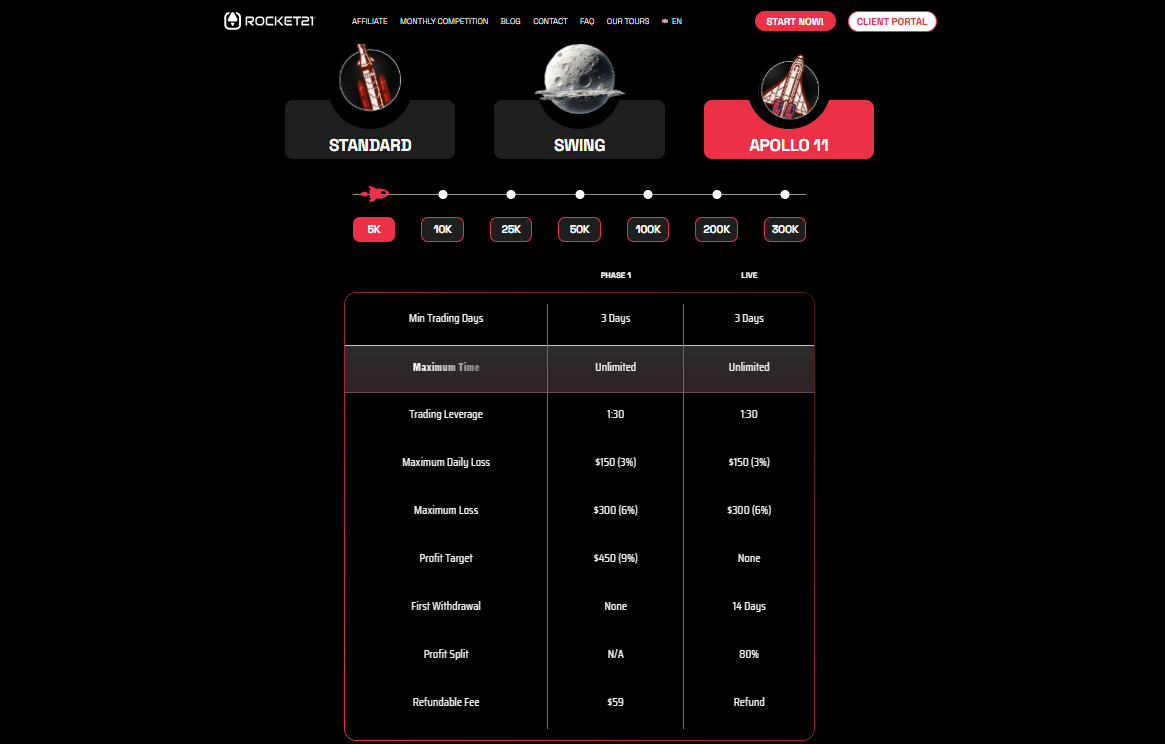
- Single-stage evaluation with a target of 9% profit.
- Profit-sharing: Up to 90% with weekly payouts.
- Registration fee refund: Provided if the trader withdraws profits successfully after passing the challenge.
- Higher entry fees :
– $10,000 account: $119
– $100,000 account: $499
– $200,000 account: $939.
-> The Apollo11 Account is ideal for professionals seeking fast-track access to large capital without the burden of a two-stage evaluation. Though more expensive, it comes with exclusive benefits such as weekly payouts and a refund on the challenge fee.
III. Account Type Comparison
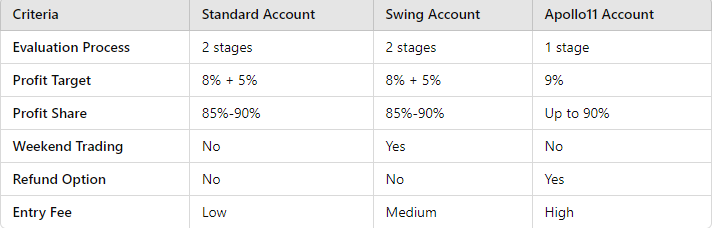
IV. Cost Analysis and Profit-Sharing Policy
4.1 Participation Fees
- Challenge Registration Fees:
– $5,000 account: 59 USD
– $100,000 account: 499 USD
– $200,000 account: 939 USD. - Withdrawal Fees:
– 50 USD for international bank transfers.
– 1% fee for cryptocurrency withdrawals.
Rocket21 does not charge inactivity or overnight fees, reducing the overall cost burden for traders.
4.2 Profit-Sharing
Rocket21 offers 85% to 90% profit-sharing, which is among the highest in the industry. The Apollo11 program even provides weekly payouts and refunds the registration fee upon a successful withdrawal.
V. Pros and Cons of Rocket21
5.1 Pros
- No time limits during the evaluation, reducing pressure.
- High profit-sharing rates of up to 90%, with flexible payment schedules.
- Revive feature allows traders to retry the verification stage if needed.
- Multiple trading platforms: DX Trade and TradeLocker are accessible on web, desktop, and mobile.
5.2 Cons
- Short operational history (launched in 2022), limiting its reputation.
- No support for MT4/MT5, which may deter some experienced traders.
- High fees for larger accounts, with limited flexibility in withdrawal methods.
VI. Recommendations for New Traders
- Start with a smaller account: Use the Standard or Swing Account to familiarize yourself with the platform and test your trading strategies.
2. Practice risk management: Adhere to the 5% daily loss limit and the 10% trailing drawdown to stay within safe trading limits.
3. Take advantage of the Revive feature: If you fail the first time, use this option to try again without restarting from scratch.
4. Join the community on Discord: Learn from other traders and stay updated on platform developments.
VII. Conclusion
Rocket21 offers a promising platform with innovative features and a flexible evaluation process suitable for both new and experienced traders. Its high profit-sharing rates, lack of time limits, and account scaling up to $2 million make it an attractive option.
However, given its short operational history and lack of MT4/MT5 support, traders should approach cautiously. Starting with a smaller account and using platform features wisely can pave the way for long-term success on Rocket21.